
Why Your Race Emails Aren’t Getting Opened (and What to Do Instead)
You wrote the email.
You hit send.
And… nothing.
Low open rates are one of the most frustrating parts of running a race.
But here’s the thing: It’s usually not because people don’t care.
It’s because your emails aren’t giving them a reason to open them.
Let’s fix that.
Your Subject Lines Are Too Generic
If your subject line sounds like this:
“Race Update”
“Important Information”
“Event Reminder”
…it’s getting ignored.
Why?
Because it looks like every other email in their inbox.
What to do instead:
Make it specific and human.
Examples:
“You’re in. Here’s what happens next.”
“Race week is here — don’t miss this.”
“Parking, start times, and what to bring”
👉 Your subject line should answer: “Why should I open this right now?”
You’re Sending Emails at the Wrong Time
Timing matters more than most races realize.
If you send everything:
too early → people forget
too late → people panic
What works better:
Follow a simple rhythm:
6–8 weeks out → welcome
2–3 weeks out → race day prep
1–2 weeks out → realistic logistics
race week → reminders and bib email
post-race → thank you and next year
👉 Consistency builds trust — and better open rates.
3. Your Emails Feel Like Admin (Not Experience)
Most race emails read like a checklist.
Bullet points.
Logistics.
Zero personality.
And while information matters — connection matters more.
What to do instead:
Add:
one sentence of energy (“we can’t wait to see you out there”)
one helpful insight (course tip, weather note)
one moment that makes it feel like a real event
👉 People open emails that feel like they’re part of something.
4. You’re Not Building Anticipation
If your emails only show up when you need something, people stop paying attention.
No story.
No buildup.
No reason to care.
What to do instead:
Use your emails to:
highlight the course
introduce sponsors
share past race moments
build excitement
👉 The best races feel like something you’re joining, not just attending.
5. You’re Not Training Your Audience to Open
This is the big one.
Open rates improve when people expect value from you.
If your emails are:
inconsistent
rushed
overly transactional
…your audience learns to ignore them.
What to do instead:
Be predictable:
same tone
clear structure
helpful content
👉 When people trust your emails, they open them.
What “Good” Looks Like
You don’t need perfect metrics.
But strong race emails typically:
feel clear
arrive at the right time
answer real questions
build anticipation
sound like a human wrote them
Want to Fix This Fast?
We put together a simple breakdown of the most common messaging mistakes races make — and how to fix them.
👉 Or join the Final Stretch Command Center waitlist
Want This Done For You?
If you’re tired of guessing what to send — or rewriting the same emails every year:
Final Stretch Co. helps races:
build better email systems
improve open rates
create clearer, more confident communications
How to Market a Running Event (Without a Full Marketing Team)
If you’re organizing a race, chances are you’re also the marketing team.
You’re answering emails.
Posting on social.
Updating the website.
Trying to keep sponsors happy.
And somewhere in there… actually planning the event.
So when people say, “Just market your race better,” it’s not exactly helpful.
Here’s the truth:
You don’t need a massive team.
You need a clear, repeatable system.
This is how to market a running event without burning out — or having to guess what works.
1. Start With a Simple Campaign Timeline
Most races don’t have a marketing problem. They have a timing problem.
Instead of posting randomly, map your campaign into phases:
Phase 1: Launch (8–12 weeks out)
Registration opens
Early bird pricing
“Be the first to join” messaging
Phase 2: Build (4–8 weeks out)
Course highlights
Community stories
Sponsor features
Phase 3: Convert (2–4 weeks out)
Urgency (price increases, limited spots)
Testimonials or past photos
“Who’s joining you?” messaging
Phase 4: Final Push (Race week)
Logistics
Reminders
Excitement
👉 This alone will make your marketing feel 10x more organized.
2. Make Email Your Core Channel
Social media is great for visibility.
Email is what actually gets people to show up.
If you only do one thing, do this well.
At a minimum, you need:
A welcome email
A mid-cycle update
A logistics email
A final reminder
A post-race thank you
Most races underuse email — which means this is your easiest win.
3. Use Social Media to Support (Not Carry) Your Campaign
You don’t need to post every day. You need to post intentionally.
Focus on:
Announcements (registration, price increases)
Visual content (course, medals, past events)
Community (runner stories, training moments)
Countdown posts
Think of social as reinforcement — not your entire strategy.
4. Integrate Sponsors Into the Experience
Most races treat sponsors like a checkbox.
Logos on a banner.
A quick mention in an email.
Done.
But strong races do this differently.
They:
Introduce sponsors in emails
Highlight them in social posts
Connect them to the runner experience
👉 When sponsors feel integrated, they come back.
5. Stop Creating Everything From Scratch
This is where most race directors lose time.
Every email → written fresh
Every post → designed from scratch
Every campaign → reinvented
Instead, build (or use):
Reusable email templates
Social media templates
A repeatable campaign structure
This is how you save hours — and stay consistent.
6. Focus on What Actually Drives Registrations
Not everything matters equally.
If you want more signups, prioritize:
Clear messaging
Strong timing
Email consistency
Visual proof (photos, videos)
Urgency (price increases, deadlines)
Not:
Perfect branding
Overcomplicated campaigns
Trying every platform at once
What This Looks Like in Practice
A well-marketed race doesn’t feel chaotic.
It feels:
clear
consistent
easy to follow
well-timed
And that’s what runners remember.
Want a Plug-and-Play Version of This?
We’ve turned this entire system into templates, calendars, and tools you can use right away.
👉 Or join the Final Stretch Command Center waitlist
Want Help With This Instead?
If you’d rather not build this yourself:
Final Stretch Co. works with race teams and brands to:
plan campaigns
build comms systems
improve runner experience
support sponsor activations
Race Day Email Timeline: What to Send (and When)
If you’ve ever found yourself writing race emails the week of your event… you’re not alone.
Most race directors don’t have a clear communications plan — which means emails go out late, details get missed, and runners show up confused.
The fix isn’t sending more emails. It’s sending the right emails at the right time.
Here’s a simple, effective race day email timeline you can use for your next event.
📅 6–8 Weeks Before Race Day: The Welcome Email
This is your most overlooked opportunity.
Most races send a basic confirmation email.
The best races send a welcome.
What to include:
A quick “you’re in” moment (make it feel exciting)
What happens next (training, updates, key dates)
One helpful tip (course insight, weather, terrain)
👉 This sets the tone for everything that follows.
📅 3–4 Weeks Before: The “Get Ready” Email
This is where runners start paying attention again.
Include:
Course overview or highlights
Key logistics (location, timing, categories)
Sponsor callout (done naturally — not forced)
This email should answer: “What do I need to know to feel prepared?”
📅 2 Weeks Before: The Logistics Email
This is one of your most important emails.
Include:
Race kit pickup details
Start times and wave info
Parking/transit
What to bring
Clarity here = fewer support emails later.
📅 Race Week: The Reminder Email
This is your “don’t miss anything” moment.
Include:
Bib numbers (if you need them for race kit pickup)
Final reminders (times, locations, deadlines)
Weather considerations
Quick race day checklist
Keep it simple, scannable, and calm.
📅 Day Before: The Confidence Email
Most races skip this — they shouldn’t.
Include:
A short, encouraging message
Final key details (bullet format)
Weather forecast and any safety considerations related to the weather
“We’ll see you tomorrow,” energy
This builds excitement and reduces anxiety.
📅 Race Day (Morning): The Final Nudge
Optional — but powerful. If your audience is on social media this could also be a great opportunity for engagement.
Include:
Start time reminder
Weather note - only if anything major has changed
One line of encouragement
This email should feel like: “It’s game time.”
📅 Post-Race (Same Day or Next Day): The Thank You
This is where most races drop the ball.
Include:
Gratitude
Results link
Photos or next steps to get them
Sponsor thank-you
Registration for next year’s event (if open)
👉 This email is your bridge to next year’s registration.
🧠 Why This Matters
A strong race email schedule:
reduces confusion
improves runner experience
increases return rates
makes sponsors more visible
takes pressure off your team
And most importantly, it makes your event feel intentional.
Need Help Building This Out?
If you want this done for you — or tailored to your race:
Case Study: The Final Stretch Co. “Participant” Ribbon Business Card
How do you design a business card that feels like crossing a finish line?
01 — The Brief
Final Stretch Co. needed a business card that felt like running culture, not corporate stationery.
The goal: create a leave-behind that captured the emotion of race day, celebrated the running community, and instantly conveyed what the company does—strategic communications for races, running brands, and sponsors.
Rather than another forgettable rectangle, the business card needed to feel tactile, nostalgic, and worth keeping.
How do you design a business card that feels like crossing a finish line?
02 — The Inspiration
The concept was born from the classic Track & Field participation ribbon—the kind many runners remember from school meets and early race days.
(Insert image: Original purple Participant ribbon)
That iconic vertical format, the metallic gold graphics, the zig-zag trim, the small stars—these elements evoke achievement, community, and the simple joy of showing up.
Because Final Stretch Co. celebrates those same values, the participation ribbon became the perfect foundation for a signature business card.
03 — The Idea
A business card you earn — not just receive.
Instead of a card, we created the Final Stretch Co. Participant Ribbon:
a custom, satin-finish ribbon that feels like an award for meaningful collaboration.
Key transformation moments:
“PARTICIPANT” becomes The Final Stretch Company
The generic runner graphic becomes Kat, the brand’s custom mascot
The ribbon’s purpose shifts from Track & Field to Brand & Race Communications
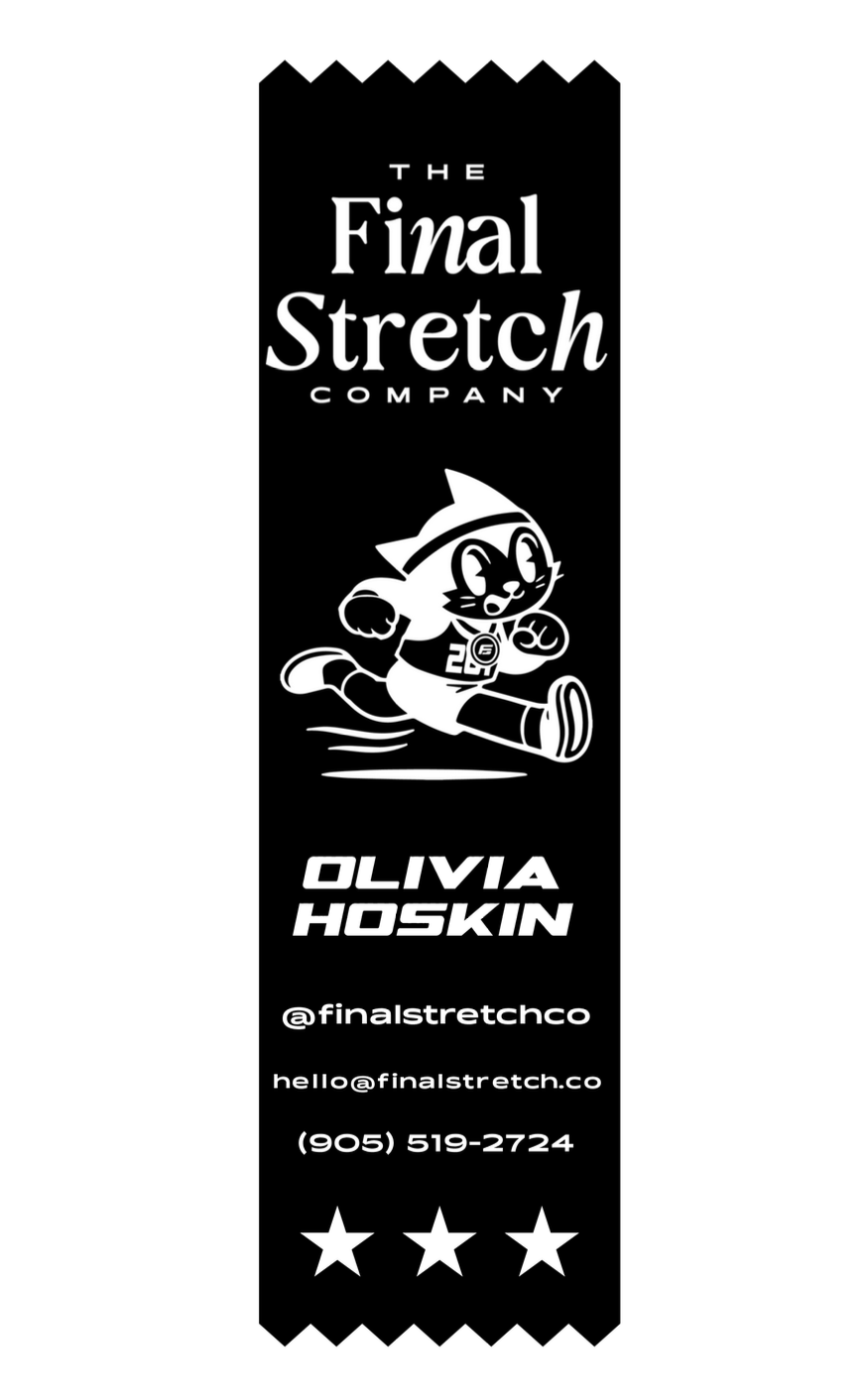
Meet Kat — the FSC Mascot
Kat is inspired by:
Kathrine Switzer, the first woman to run the Boston Marathon
Astroboy and Japanese character design
Felix the Cat, the first animated film icon
She’s energetic, charming, always in motion—an embodiment of the running spirit and Final Stretch Co.’s “finish strong” ethos.

Vintage track and field ribbon.
04 — Typography & Visual System
The ribbon uses a high-contrast type pairing that blends vintage athletic energy with modern clarity:
Groning — for bold, kinetic headers (OLIVIA HOSKIN)
Kinetica — for clean, legible contact details
The star trio at the bottom references classic award ribbons, while the zig-zag trim mirrors traditional fabrication.
The ribbon is printed in FSC’s brand teal with white ink for maximum contrast and readability.
05 — The Process
Archival research: reviewing historical Track & Field ribbons
Character development: designing Kat with a vintage-meets-modern aesthetic
Typography testing: balancing athletic boldness with legibility
Prototyping: adjusting ribbon length, width, and color saturation
Production: satin-finish stock, embossed details, custom die-cut trim
The physical version was produced in small runs for conferences, client mailers, and partnership kits.
06 — The Outcome
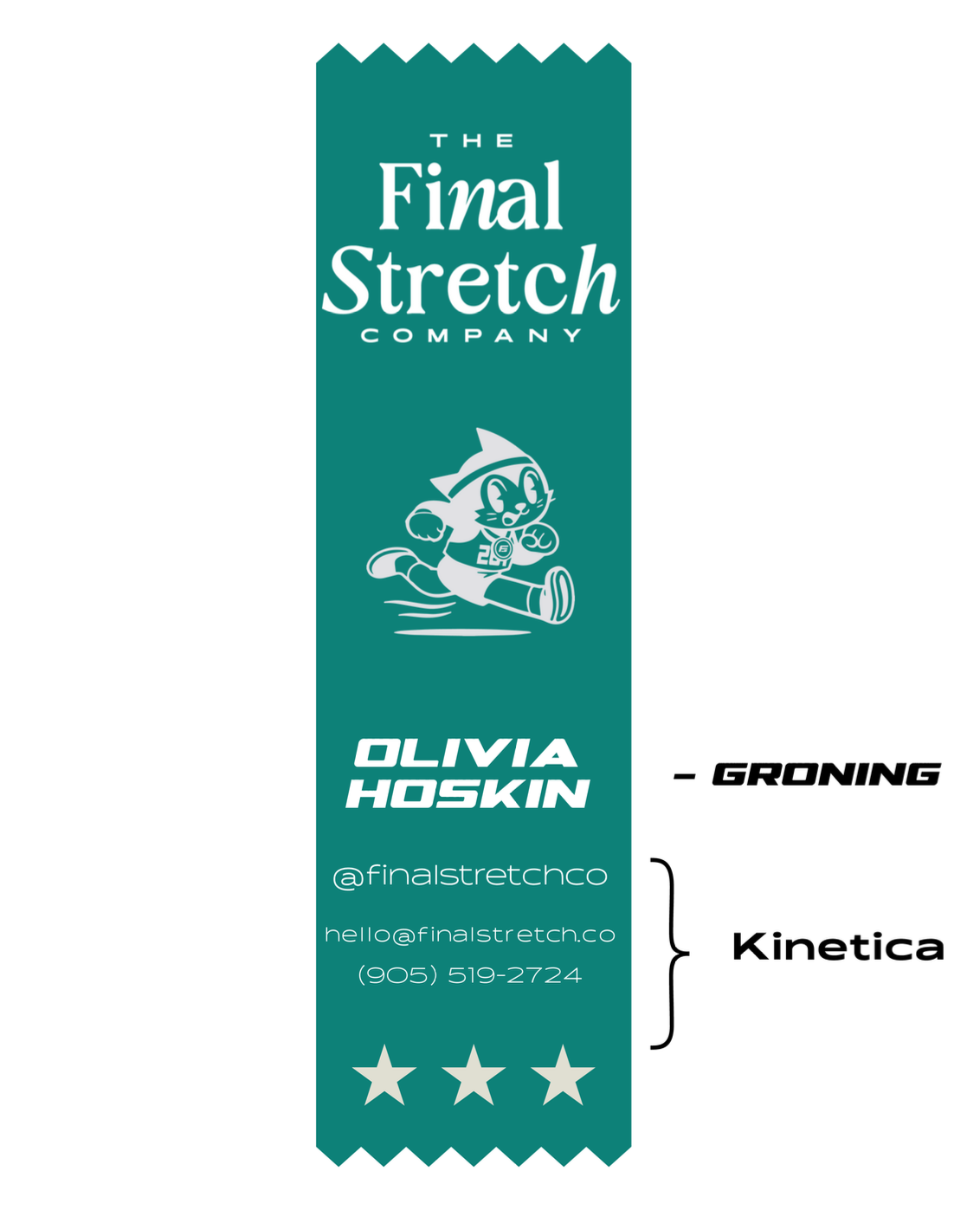
Final Stretch Co. “Participant” Ribbon Business Card Design
The FSC Participant Ribbon is more than a business card—it’s a conversation starter.
At events, people keep it, display it, photograph it, and immediately understand the brand personality behind it.
It communicates three things instantly:
We work in running.
We think differently.
We believe showing up matters.
“It only made sense that the Final Stretch Co. business card would be something you get for finishing strong.”
— Olivia Hoskin, Founder
The ribbon now serves as one of the company’s trademark brand touchpoints, bridging nostalgia, sport, and storytelling in a way no standard card ever could.